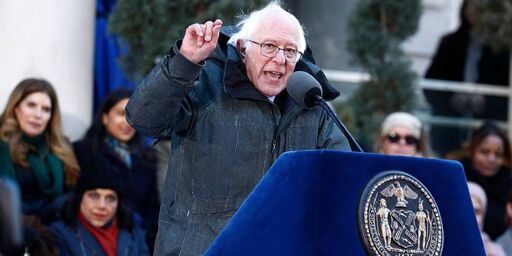
Elon Musk's $10 million donation to GOP candidate Nate Morris signals his intent to influence the 2026 midterms, sparking criticism from Bernie Sanders and Matt Dunlap.
the title of the post is the title of the article, which is pretty good practice when relaying a news article on social media.
the title of the post quotes a question asked by B. Sanders.
what you know of op makesyou claim that he asks the question in bad faith.
I remark op isn’t the one asking the question.
I add that it’s a rhetorical question.
Now to answer your last comment, what I was getting at with my second point, and which is maybe not that all pertinent in hindsight, is that it’s kind of hard to make out from a rhetorical question alone what the author ‘s stance might actually be exactly. Maybe Sanders thinks that the extent of Musk’s donations might suggest the US not being a true democracy, maybe he thinks that this is in contradiction with an otherwise healthy democracy, maybe he thinks there’s nothing democratic about the current US political system ; or any shade between these. All in all, the conclusion is left to the reader.
In light of all this, the fact that op could be a bad actor is not very pertinent : it’s not his words, and even if it was, the nature of the question and its effect on the reader is quite open ended and IMO not as manipulative as « bad faith » would imply.
Edit: the important point being that op is not the author of the question. The rhetorical question remark was first and foremost there to point it out in case you missed it.
To be on the same page look at comments of OP. Bad faith takes a lot of faith on your end. So in the end you’re sticking out your neck for a commenter who basically says the left half of the country is GeNoCiDaL for Fox News… all while the right half upvotes.


How does a rhetorical question help your statement? How does a rhetorical q asked in bad faith make anything better?
What are you really getting at?
Just to be sure that we are on the same page:
Now to answer your last comment, what I was getting at with my second point, and which is maybe not that all pertinent in hindsight, is that it’s kind of hard to make out from a rhetorical question alone what the author ‘s stance might actually be exactly. Maybe Sanders thinks that the extent of Musk’s donations might suggest the US not being a true democracy, maybe he thinks that this is in contradiction with an otherwise healthy democracy, maybe he thinks there’s nothing democratic about the current US political system ; or any shade between these. All in all, the conclusion is left to the reader.
In light of all this, the fact that op could be a bad actor is not very pertinent : it’s not his words, and even if it was, the nature of the question and its effect on the reader is quite open ended and IMO not as manipulative as « bad faith » would imply.
Edit: the important point being that op is not the author of the question. The rhetorical question remark was first and foremost there to point it out in case you missed it.
To be on the same page look at comments of OP. Bad faith takes a lot of faith on your end. So in the end you’re sticking out your neck for a commenter who basically says the left half of the country is GeNoCiDaL for Fox News… all while the right half upvotes.