This actually isnt that weird, happens all the time
However, its less common that it impacts a common consumer product of the same type.
But a thing to be used in making a huge project causing prices to shoot up ahead of time is very normal.
Its just usually stuff like concrete, steel, lumber, etc that is impacted the most, but turns out RAM as a global industry wasnt ready to scale up to a sudden huge spike in demand.
Give it a couple yesrs and it’ll level out as producers scale up to meet the new demand.
They will. Otherwise they’re throwing money away and leaving room in the market for competitors.
The big problem, though is that DRAM manufacturing requires a shitton of money to make and you’d have to poach talent from existing players. Otherwise you’ll never be able to get started. It’s just too complicated.
China has been trying to catch up with Taiwan in chip manufacturing for like 20 years now and they’re still at least 10 years behind. Probably 15 or more because of the way funding/investment works over there.
Otherwise they’re throwing money away and leaving room in the market for competitors.
Nope. Their costumers are throwing so much money at AI boondoggles that wasting time, materials, and manpower on the current tech bubble is now the most profitable move for the hardware producers.
It’s the Shoe Event Horizon, except in stead of everyone being depressed and buying shoes, it’s a dozen billionaires becoming so greedy, arrogant, and shortsighted that they swallow an entire cornerstone industry for their latest obsession.
Right! The manufacturers know this is a bubble and aren’t going to put themselves into debt to build new factories! They’re going to ride the bubble til it pops and then try to go back to normal, but significantly richer.
“As long as the music’s playing, you’ve got to get up and dance.”
That’s Citi’s former CEO, who explained that he would devote his company’s resources to making money in a bubble (during the 2007 housing bubble), even when he knew it was a bubble.
The memory chip producers are absolutely going to try to maximize production during this bubble. The normal life cycle is to run fabs on offsetting cycles where at any given time, the company has a few fabs in the planning stages, in the construction stages, R&D stages, early “risk” production, high volume production, and retooling for a new process.
That means that during a bubble, it makes sense to try to accelerate the speed at which new fabs come online or old fabs get retooled. It makes sense to keep old fabs running longer at higher yields, even for previous generation product. These aren’t mature businesses that were already planning on running the same factories forever. They already anticipate the cycle of multiple generations, and what that looks like is going to be more aggressive during periods where customers are throwing money at them.
I just don’t understand how selling everything they produce increases costs. Are they just charging more for more profits, or is the increased prices funding increased production?
The vast difference in economics between retail and manufacturing don’t make sense to me.
Easy. They always sell the amount they produce. However only when they lower the price. Nobody with a sane mind pays 150 € for 8GB of RAM.
However what if they already sold everything and even future products to someone and have the money already? Well now you have the same demand but no supply. Of course demand falls with increasing prices, but your supply is so limited that you want to reach the sweet spot where someone still pays that much for it and where you still sell everything you have left.
Let’s say I harvest 100 apples a year and my neighbours buy 70 each year I basically only charge as much as it costs me to harvest them so I have a little winnings. Because if not they will buy from someone else.
But now someone buys all the apples he can get. Now I sold 98 apples and my neighbours still want to buy 70. Well at some price they will only want to buy 2.so I charge 500 per apple, because I am greedy.
A bigger share of the current factory output is being routed to the tech companies rather than the consumer component shops meaning there’s less to go around. Since there’s less to go around, consumer-facing stores are forced to bid higher to be able to maintain their stock which is then passed on to us plebs
My micro economics would tell me it’s that the demand curve is shifting upwards, while the supply curve is at best the same, of not going lower (currently), so the intersecting price where they meet goes up. While it may be artificial, more demand on the same supply increases prices typically. Depending on the elasticity of the demand for the product (toys VS household electricity costs for example), the market will bare the increases if it deems it essential.
But those were lessons from 15 years ago, this brave new world of open corruption and greed have probably up ended some of those concepts. The circular fake economy of a half a dozen tech companies can probably only sustain itself for so long, I guess we’ll see how it all pans out

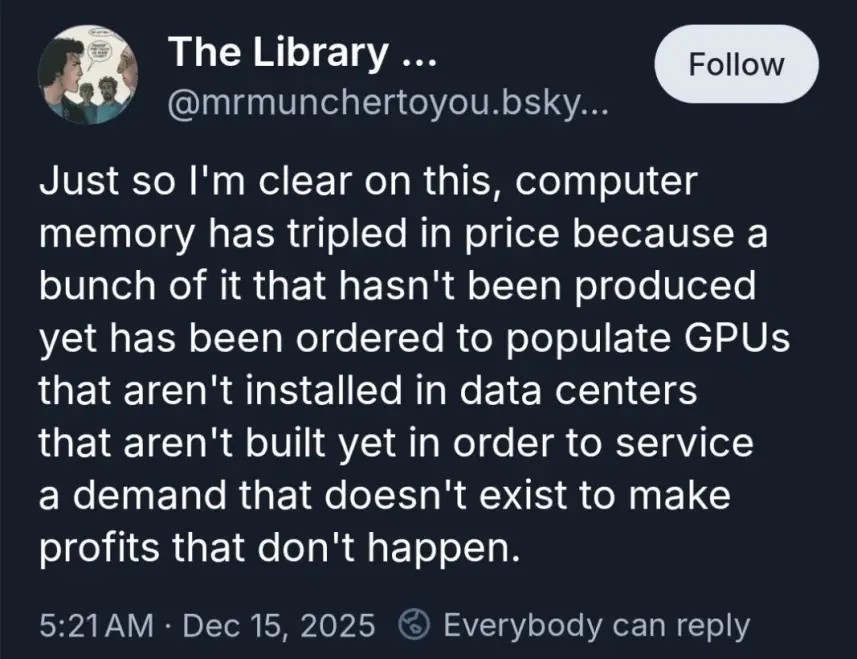
This actually isnt that weird, happens all the time
However, its less common that it impacts a common consumer product of the same type.
But a thing to be used in making a huge project causing prices to shoot up ahead of time is very normal.
Its just usually stuff like concrete, steel, lumber, etc that is impacted the most, but turns out RAM as a global industry wasnt ready to scale up to a sudden huge spike in demand.
Give it a couple yesrs and it’ll level out as producers scale up to meet the new demand.
The producers have announced they will not increase production
They will. Otherwise they’re throwing money away and leaving room in the market for competitors.
The big problem, though is that DRAM manufacturing requires a shitton of money to make and you’d have to poach talent from existing players. Otherwise you’ll never be able to get started. It’s just too complicated.
China has been trying to catch up with Taiwan in chip manufacturing for like 20 years now and they’re still at least 10 years behind. Probably 15 or more because of the way funding/investment works over there.
Nope. Their costumers are throwing so much money at AI boondoggles that wasting time, materials, and manpower on the current tech bubble is now the most profitable move for the hardware producers.
It’s the Shoe Event Horizon, except in stead of everyone being depressed and buying shoes, it’s a dozen billionaires becoming so greedy, arrogant, and shortsighted that they swallow an entire cornerstone industry for their latest obsession.
Haha, referencing the Shoe Event Horizon made me stop and pay attention!
“Shit. Maybe they’re right… We could be about to evolve into bird people!”
Right! The manufacturers know this is a bubble and aren’t going to put themselves into debt to build new factories! They’re going to ride the bubble til it pops and then try to go back to normal, but significantly richer.
“As long as the music’s playing, you’ve got to get up and dance.”
That’s Citi’s former CEO, who explained that he would devote his company’s resources to making money in a bubble (during the 2007 housing bubble), even when he knew it was a bubble.
The memory chip producers are absolutely going to try to maximize production during this bubble. The normal life cycle is to run fabs on offsetting cycles where at any given time, the company has a few fabs in the planning stages, in the construction stages, R&D stages, early “risk” production, high volume production, and retooling for a new process.
That means that during a bubble, it makes sense to try to accelerate the speed at which new fabs come online or old fabs get retooled. It makes sense to keep old fabs running longer at higher yields, even for previous generation product. These aren’t mature businesses that were already planning on running the same factories forever. They already anticipate the cycle of multiple generations, and what that looks like is going to be more aggressive during periods where customers are throwing money at them.
I just don’t understand how selling everything they produce increases costs. Are they just charging more for more profits, or is the increased prices funding increased production?
The vast difference in economics between retail and manufacturing don’t make sense to me.
Easy. They always sell the amount they produce. However only when they lower the price. Nobody with a sane mind pays 150 € for 8GB of RAM.
However what if they already sold everything and even future products to someone and have the money already? Well now you have the same demand but no supply. Of course demand falls with increasing prices, but your supply is so limited that you want to reach the sweet spot where someone still pays that much for it and where you still sell everything you have left.
Let’s say I harvest 100 apples a year and my neighbours buy 70 each year I basically only charge as much as it costs me to harvest them so I have a little winnings. Because if not they will buy from someone else.
But now someone buys all the apples he can get. Now I sold 98 apples and my neighbours still want to buy 70. Well at some price they will only want to buy 2.so I charge 500 per apple, because I am greedy.
A bigger share of the current factory output is being routed to the tech companies rather than the consumer component shops meaning there’s less to go around. Since there’s less to go around, consumer-facing stores are forced to bid higher to be able to maintain their stock which is then passed on to us plebs
At that scale it’s kind of like an auction for the capacity to produce the chips (and it’s the DRAM chips, not the finished modules in this case).
So for a DIMM retailer to get enough chips to make a product they need to out bid Nvidia :-(
My micro economics would tell me it’s that the demand curve is shifting upwards, while the supply curve is at best the same, of not going lower (currently), so the intersecting price where they meet goes up. While it may be artificial, more demand on the same supply increases prices typically. Depending on the elasticity of the demand for the product (toys VS household electricity costs for example), the market will bare the increases if it deems it essential.
But those were lessons from 15 years ago, this brave new world of open corruption and greed have probably up ended some of those concepts. The circular fake economy of a half a dozen tech companies can probably only sustain itself for so long, I guess we’ll see how it all pans out