The shift in the meaning of Liberalism in representative government started in the 1970s as a response to Stagflation and Reaganism.
When talking about Liberalism in the context of modern western representative governments it now generally refers to the belief that liberal free market economics is the best way to a prosperous society (a rising tide lifts all boats, if people don’t want something they won’t buy it, the market has a role in government).
This is called the Third Way or Third Way Economics. This was when the belief that a good society is created by providing a good quality of life ended, and the new viewpoint that a good society is created through creating and protecting the best condition for business started (meaning deregulation, privatisation, a two tier legal system, privatization of profits, socialization of costs).
In terms of modern representative government, that’s what liberalism now means. Liberals believe the protection of business conditions leads to a prosperous society and quality of life.
This put the government in the role of serving whatever businesses and industries said they needed, and we’ve been there ever since.
Well said. I was reading through all the points in the post thinking liberals don’t believe any of this stuff, save for maybe a couple of the points.
 😁
Thanks for fixing it, much better.
Can I get a fuck yeah?!??
Give me an F!
FUCK YEAH!
Fuck yeah you can.
take my upvote
Much better
Beautiful.
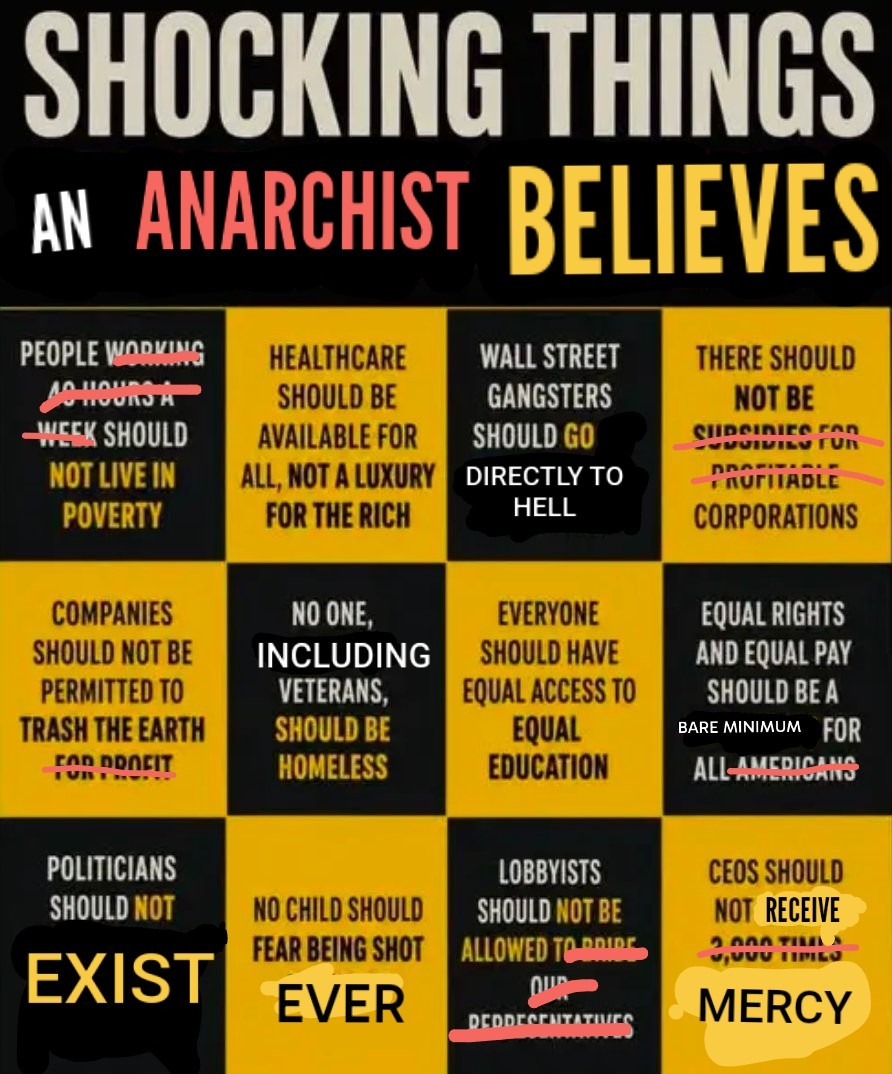
Lobbyists are not necessarily a problem. Lobbyists for corporate interests are usually a problem. But there are lobbyists for non-profits, unions, and advocacy groups, too. Their job is to be a face to face to those with political power and government authority to advocate for some interest. Those interests are can be a net good for everyone. They can bring awareness to issues, new perspectives on issues, and provide a voice for those who may otherwise be ignored or lost in the noise. There is nothing wrong with that in itself. When bribery gets involved, or behind the scene deals, or when lobbyists get to write the laws to financially benefit their employers at others’ expense, that is the problem we often see with lobbyists.
Update: y’all hate some nuance, huh.
But there are lobbyists for non-profits, unions, and advocacy groups, too.
Correct, but those interest groups should be allowed some kind of formal consultative role in the political process, rather than being forced to throw money around
The lobbyist is the consultative role. Their job is to consult. The only money that needs thrown around to lobby is the salary of the lobbyist. Now because we have a corrupt system that does not suffiently enforce the law, plenty of lobbyists throw around money to gain favors and deals with government officials, and that obviously should neither be the expectation or even allowable. But that doesn’t made a paid role as a person who job is to advocate for some cause inherently a problem, so long as they do so ethically and, ideally, for a worthy cause.
So, I think the people doing that job should be making standard working class wages, and they should, for example, be elected by their respective interest group organisations to a formal legislative body that consults on and can propose legislation, but not pass it.
Like the house of Lords, but instead of being full of rich people named Baroness Killthepoor, it’s an actually useful body.
Lobbyists are an informal adhoc means of essentially legalizing bribery, that has been codified over time. While legitimate good might come from that system, as you’ve pointed out, some kind of formal democratic system by which formalise and democratize that consultative role should be enacted.
That’s not a the worst idea in premise, but the logistics of that is a concern for me.
Who decides who is allowed to be a formal interest group with a vote in the body? Is anyone allowed to form any group that has equal voting power? That is a terrible idea for so many reasons I can think of. Is it chosen by the legislature or executive? That gives it a ton of room for corruption, favoritism, etc. Are they restricted to one group per area of interest? If not then you could have proposals passed by the sheet number of co-interested individual interest groups alone. If not, then who decides what is a distinct enough interest to allow a new group?
That being said, the entire system being an above board process, publically accessible and answerable, would already be a dramatic improvement over the current lobbying practices, so… no matter how bad a mess, it likely would never be worse.
You’re thinking within the confines of the suboptimal system we currently have. What if lobbying wasn’t useful because there was no central authority figure to plead with? What if nobody’s voice gets lost in the noise because the people who can help are near enough to hear them?
You may have missed it, but this is an anarchist take, so your argument doesn’t really apply, whether it’s true or not.I’m not an anarchist. And we don’t live in an anarchy. And we will never see a true long term anarchist society of any real scale in our lifetime. That is fine if you are talking about some idealistic utopian goal. But I’m talking about the world we live in now.
And they didnt say that they shouldn’t be necessary or viable because there is no central goverment authority to advocate to. They said they shouldn’t be allowed. Those are two different stances (and not very anarchist to talk of disallowing advocacy roles).
Yeah. Nuanced thought has no place in lemmy. This is where kids go to get programmed by manufactured outrege and polarized idealism.
Cosigned
How does “people should not like in poverty” fit with anarchy? I’m asking out of curiosity, not to be contentious.
Supporting unemployed or disadvantaged needs collectivism, some system to contribute to people in need, which then also needs some kind of tax collection and governance. Do anarchists expect individuals to support people in need as their own independent choice?
How does “people should not like in poverty” fit with anarchy? I’m asking out of curiosity, not to be contentious.
Rich vs poor is a garbage social hierarchy.
Supporting unemployed or disadvantaged needs collectivism, some system to contribute to people in need, which then also needs some kind of tax collection and governance.
This is just capitalist/statist assumptions within the hegemonic narrative.
People don’t need “some system” to solve poverty. People need to end the current system that creates and depends on poverty.
Poverty is (supposedly) a made-up metric in result of capitalism. If capitalism no longer exists any worker gets enough to escape poverty just by working
How? How is that enforced? How are resources distributed? How can any of that actually work in practice?
Supposedly
I do not defend this statement
Yeah. See. You can’t ask lemmy “anarchists” questions. They only know how to yell at you about shit that only works in their heads.
You misspelled “progressives.” Liberals are capitalist conservative corpos and actively enable all of these problems.
Fucking THANK YOU! Liberalism and progressivism are not related. “Liberal” is a pejorative made popular by neoliberal cockroach Ronald Reagan.
People who believe in capitalism (ie liberals) can still want all these things. Look at the Nordic countries as examples. Ultimately leftism is the way to go but despite what the tankies on here scream about every liberal is not a fascist.
As I understand geopolitical definitions, “progressives” are the leftmost slice of the larger “liberal” envelope.
It’s like you’re saying, “No, bugs don’t fly. Just look at this centipede!”
That and/or No True Scotsman.
Naw, in the US Liberalists stand in the way of Progressives. They are not on the same team because one is radical in nature and the other is conservative.
While the strict definitions will muddy these two terms most people who understand what is going on resist this trap.
Never heard of the term “Liberalist” before. Is that some hip new way to refer to liberals?
By every definition of “progressive” and “liberal” I know, they overlap.
A liberalist is someone who advocates liberalism.
Yes, as I said traditional definitions will muddy these waters. That is why I said in the US.
Liberalists regularly work against progressives in US politics. If they are the same then why are they opposed?
A liberalist is someone who advocates liberalism.
… bruh.
So to you, a person who advocates fascism is a fascistist?
Liberalists regularly work against progressives in US politics. If they are the same then why are they opposed?
Because they are on opposite ends of the same area of the political spectrum, obviously. Same reason groypers don’t get along with MAGA.
It is the definition of the word. Not sure where you are going. You would prefer me to use liberal instead of liberalist…? The problem is a liberal doesn’t necessarily advocate for liberalism. A liberalist does. A progressive advocates for progressive policies.
Progressives want to reform liberal systems that are broken. You can keep pretending they are the same all you want, but they are diametrically opposed in the US.
It’s just inane splitting of hairs - a pointless distinction.
What do you call a fascist that spreads fascism? A fascist.
What do you call a fascist that doesn’t spread fascism? A fascist.
LMAO.
NO ONE, ESPECIALLY VETERANS, SHOULD BE HOMELESS
Would be better without the ‘especially veterans’ part. WTF makes veterans so special? Why is a homeless veteran more concerning than any other homeless person?
I am a veteran, by the way. But fuck this shit.
I didn’t make it, if I did it would have been that way.
MAGA & GOP view themselves as the pro-military party, which is really important because it means veterans often vote for them. The reality is MAGA & GOP is happy to vote for more military spending of the variety that puts money into the military industrial complex. They are way less willing to spend it in ways that benefit actual veterans.
I’m against war & the military and do not think highly of those that join. That said they are, technically, a public servant. And public servants should be granted public resources such as housing & healthcare & food. So yes, ‘especially veterans’, should get housing.
But also yes, everyone should.
I’m not pro military by any stretch of the imagination, but I see this fundamentally as an employer’s duty of care.
If you hire people to do a job, and that job results in lasting damage, you should be liable (morally and civilly) for fixing the damage. Anything else is just pushing the externalities off to society at large.
Then why specifically talk about Veterans and not, for example, Firemen. Surelly the contributions for society of the latter are vastly better than the former - in fact, in the US the former have always been used to pillage the resources of foreign nations (there has literally not been a military attack on the US for over a century, so it sure ain’t Defense), resources then overwhelmingly captured by a select elite which is thus made even richer, hence more powerful, hence more politically influent, the very opposite of the “Liberal thinking” that document claims to portray.
It looks to me like either the author of that is American and that shit is them leaking their lifelong brainwashing about the Military or it’s a piece of political propaganda whitewashing Liberalism (what’s in that list sure as hell does not match the actual policies of Liberal Politicians) which targets Americans hence blowing the “Veterans” dog-whistle, which pretty much only works in America.
The US doesn’t have an established history of firemen homelessness. The homeless vet abandoned by a stingy and heartless government is an established trope in American culture. That’s not remotely true for firemen. Calling out veteran homelessness is a useful tactic, people do it because it can cut across the normal boundaries of partisan politics.
Also, there technically have been a few military attacks on the US within the past century but they were not especially effective. During WW2 the Japanese military hit the US west coast a few times in submarine attacks, they also had a campaign of balloon bombings which killed a number of people in Oregon.
I think the government owes more to veterans. I do not think they inherently deserve more as a moral imperative of the universe.
Because it frames the homeless issue in an undeniably harsh light. “If even vets end up homeless, WTF are we doing?!”
Logically, anyone homeless should be given enough to basically survive, but it’s usually drugs or psychosis, and it’s hard to morally force people into treatment.
In this case, I feel it’s being used as a right / moderate driving point.
Cuts both ways, though.
The government hired the vets.
‘We’ hired the government.
If, in the course of duty, a veteran got fucked up enough mentally/physically/pharmasudically, that they can’t function in society. The government (which we hired) owes it to them to try to make it right. Not like here’s your house and you car and 1-800-EAT-STEAK, but like here’s your support line, here’s a small apartment with a working bathroom and someone to check up on you.
Worst case, a service member fell down a dark path through no fault of the military and gets complimentary help, well, good news, we also think that everyone should get that complimentary help.
There are already housing plans, funding and assistance plans for vets, just take a little of that massive fucking defense budget and look after at least the people who did the fucking burn pits back in the day.
Housing first works.
I mean honestly, as a non veteran, they risked more than most of us civilians have ever had to risk for our nation’s security. And by Nation I mean the people, not the country. So yes I do believe all veterans should be entitled to certain benefits above and beyond the average citizen. The same was true for soldiers in ancient Rome.
No, that’s why this debate exists in the first place. Not a single US soldier alive today except the very few remaining who were stationed at Pearl Harbor ever engaged in defending the nation - and even the Pearl Harbor scenario is debatable because the US illegally occupies Hawaii and had we not been illegally occupying Hawaii it wouldn’t have been attacked.
Every single veteran alive today that needs intensive medical care received nearly all of their damage fighting wars of choice and aggression, not defending the US
I agree that every war since WW2 has been unjustified, but the soldiers did not know that when they enlisted. They still chose to risk their lives to defend our nation. You can hate them as much as you want, but many of them sacrificed their lives and their limbs for our security.
The Nazis were funded and supported by American businessmen. American involvement in WW2 wasn’t justified. It was an attempt to salvage Western fascism from destruction by the Soviets. That’s why the Americans worked with the Vatican and the Red Cross to save 10k Nazis from Nuremberg.
But I don’t hate veterans. I just think the reason they deserve care is not based on whether they did anything to protect the US.
Hey, how about this hot take: Pedophiles should not be a fucking head of state.
Oh, so now conservatives can’t be leaders at all?! Totally unfair!
Woah, woah… That’s a bit too radical. Reel it in a few notches and we can have a grown-up discussion /s
That’s a good’n right there.
Fixed it

You made it leftist but forgot to change the title.
Normies don’t generally understand this distinction.

Wait did you beat me to it? 😆

It’s so lovely watching pedantic, ideologically uncompromising nitwits “scorpion and frogging” us to the end of civilization.
See you all in hell!
I thought you were overreacting. I’m sorry.
I don’t agree with the “especially veterans” part of the no one should be homeless. Veteran status, in itself, does not make one more worthy of a basic necessity of life. What I will agree with is that the government has a responsibility to make sure everyone is house especially veterans. The government owes them more than others for serving them. The universe does not.
It’s a key point to engage the moderates and the right, but fighting it risks sliding down the “all lives matter” slope.
The government hired them and fucked them up; the government owes them support. We (royal we) ‘let’ the government get to this point, even if it’s not specifically you and I. Our taxes going to that end is far from a travesty. Let’s cut back a little on defense and use the savings to prop up the guys that got fucked up on it’s behalf.
I don’t disagree with any of that. But if you’re framing the homelessness problem as a veteran homelessness problem then the applied solutions will likely leave non-veterans that still need help without. All homelessness is a problem. That is not the same as “all lives matter” because homelessness isn’t primarily a problem that veterans face. They’re estimated to make up 5 percent of the homeless population.
The government does have a particular responsibility to vets, and should be fixing that. But they have a responsibility to non-vets too. And the things that cause homelessness for veterans causes it for everyone else too. We can and should be helping veterans by addressing the root causes that effect everyone. But any solution that only results in helping vets (like supplying only veterans housing) when they could be helping everyone is unacceptable, particularly as plenty of people would consider the job done so long as the homeless that remain aren’t vets.
You mistook my answering the veteran part only as framing, no, we can easily afford to house anyone that is willing to be housed. (some homeless will refuse help/treatment even if they need it)
Access to clean drinking water should be a right.
That would require an illiberal regulation of the commons to protect it from individual autonomy, and Liberals HATE the commons and love individual autonomy
I’ve seen your post history, You don’t have the authority to speak for “Liberals”
At this point I’m increasingly convinced the purpose of lemmy.ml is to strawman liberal ideology to make a performance of cutting it down.
Every time I stumble upon one of their memes and disagree with a slice of how it portrays liberals (ostensibly including myself), I’m vivisected for it.
LOL. Liberal isn’t a fucking identity. It’s a political philosophy with a rich and storied history, major foundational texts, and actual meaning. The fact that you think only Liberals can talk about Liberalism is exactly the sort of brainrot that makes contemporary Liberals so fucking intolerable and unmoored from reality
trolling isn’t an identity either but man do you try :)
blocked, move along
Way to prove the point
What if I told you that words change with modern context? Perhaps instead of clinging to your Ivory Tower and poring over your historical “texts” you could pull your head out of your ass long enough to recognize that modern liberals have different values and a more distinct identity than the original label would suggest.
Isn’t it funny that I am the one taking an international and historical perspective, developing my understanding of political terms from the actual historical and contemporary movements from all parts of the political spectrum and how their own histories are present in their current formations but you are the one saying “don’t do any of that just sit in this room with these specific people at this time and define everything in terms of what we say about ourselves without any interaction with anything else” and you think I am the one with my head up my own ass. You are literally smelling your own farts in a locked room and telling me that I don’t actually understand your fart smell because I won’t lock myself in the room with you.
Liberals love to accuse “the right” of being anti-intellectual but the minute anyone actually studies politics internationally and across time and domains liberals become the anti-intellectuals.
Sorry but the liberals in governments all over don’t act like they believe much of this at all.
Liberal in the US seems to mean something different than anywhere else. Most classifications don’t line up that way, though the far right extremism seems to be aligning across countries since 2016.
Yes, but that would make this make even less sense. The US sometimes uses liberal as a stand in for left-leaning. The more common definition is against regulation, so sometimes socially liberal, but also, and more importantly market liberal (think Argentina’s president for an extreme example). So this is very us liberal coded, just with goals far exceeding what most us “liberal” politicians currently try to achieve.
Look mate, if you go check the definition of “Liberalism” in Wikipedia it’s literally self contradictory.
For example, the whole Private Property Rights shit collides with the Freedom part - give people the right to own Land and to do whatever they want with their Land (which includes keeping other people out of it or from using it) and that lowers Freedom for everybody else who now can’t access that Land.
Ditto for other shared resources - if somebody owns them, others can’t use them.
Ownership of those for which “no more of it is being made” (most notably Land) is probably the keystone of inequality, not just modern day but all the way back to the time when Monarchs took ownership of the Commons.
Liberalism is like the Bible - there’s something in there for everybody but the whole thing is a self-contradictory fable promising people that they too will one day be in bliss (one promises Heaven, the other promises the possibility of becoming Rich) as long as they keep being obedient sheep.
There are many definitions of the word “liberal”. Which one are you using?
The political ones, pick any used commonly in the US and they won’t match up with their use in other countries.
The political ones

I’ve lived many years in 3 different countries in Europe.
In none of them were Liberal politicians making policies in accordance with the ideas listed in your post.
Worse, the more openly “Liberal” the party the harder they defended the very opposite of most of what’s there.
I literally do not know of a single “Liberal” party anywhere in the West which does not practice pretty much the opposite of that - they’re all pro-privatisation, pro-deregulation and more broadly their policies generally increase the Power of Money whilst decreasing the Power of the entities controlled by the Democratically Elected representatives of the citizens (i.e. the State, which is controlled by the elected representatives of citizens).
In practice every single on of them has policies which de facto reduce the powers controled by voting - which is equal(-ish) for everybody - and increase the powers controlled by Money and Asset Ownership - which is spectacularly unequal, with some having literally billions of times more power than others - or in other words, to replace Democracy with Oligarchy.
The Liberals here just want to burn coal in peace.
Its the difference between classical liberalism and modern liberalism. Classic liberals believe in laissez-fare policies and the free market, while modern liberals still believe in a market economy but support more social policy and government involvement in things like infrastructure, health, education etc.
In most places “liberal” refers to classical liberal, whereas a modern liberals would more likely be termed progressives or the centre left. In the US liberal tends to refer to modern liberals while classical liberals are referred to as conservatives.
The ‘modern liberals’ in the US government have been resisting social policies like single-payer healthcare and ~50% of OPs image though. Aside from like 4 people who’ve been outnumbered or just paying lip-service. Is what I meant in my comment.
Yeah that’s fair, sounds like they have ditched their modern liberal roots and are just acting as classic liberals, so just conservatives in liberal clothing
The example of the US Democrats (and pretty much every single western mainstream party which is supposedly left-of-center) doesn’t show a Modern Liberalism that matches what you claim is the modern one.
I think you’re confusing Left-wing Liberalism with “Modern”.
Left-wing Liberalism is basically Social Democracy - trying for Equality of Opportunity rather than trying for Equality of Outcomes like Socialism, totally accepting of private ownership and favoring mechanisms like Public Education and Progressive Taxation rather than more Autoritarian ones to try and make for a more equal world.
Right-wing Liberalism is Neoliberalism - basically “the Power Of Money should be above the Power Of The State”, only it’s all wrapped up as “the State should not own anything and should not interfere in the Free Market”. A nation where Money sits above the State in the power hierarchy can’t a Democracy even with a vote and elected representatives since what those elected representatives control - the State - sits below what Money controls, and such power structure is actually known as an Oligarchy.
(If I remember correctly there is actually an MIT study for the US that shows that it is in fact and Oligarchy and has been so for more than a decade)
In the modern days Right-wing Liberalism has been dominant in the West, something you can see even in Scandinavia which were maybe some of the last western nations were social-democracy was still dominant (until maybe a decade ago).
All this to say that in practice the present day (hence, “modern”) Liberalism in pretty much all of the West is the right-wing take on Liberalism - Free Market Liberalism, aka Neoliberalism.
“modern” doesn’t mean present day. “Contemporary” means present day. “modern” is either a grand social movement (modernism - break from tradition, urbanization, industrialization, technologically infused, experimental) or it’s a time period (1500 - ?1970s?)
Modern Liberalism is not “present day liberalism” it’s a form of liberalism that emerges in industrial societies, as opposed to, say Jeffersonian liberalism which was entirely about the freedom to buy, sell, breed, rape, and kill people you owned for the purpose of getting rich from cash cropping farms you owned on land you got by genociding subhuman natives.
Indeed under that use of “Modern” you are correct and Liberalism in the first half of the 20th century was as that poster described.
However “Modern” is also often used as short for “Modern Day” which is an expression for things from the recent past and present day rather than the formal “Modern” classification in History, and what you described as “Modern” Liberalism does not match the “Modern day” practice of Liberalism.
Since I don’t quite see the point of talking about Liberalism from more than half a century ago in the context of a post which is literally about what Liberalis believe (Present tense, hence about Present Day Liberalism), I assumed the previous poster meant Modern in the sense of “Modern day” as that version of Liberalism was the one that made the most sense to talk about in that context.
If the previous poster meant “Modern” in the “Modern day” sense as I claim, then they’re ignorant (which is the point I was making), if however them meant it as the Historical classification of Modern as you say, then they were either being deceitful (by talking about Historical Liberalism whilst trying to pass it for present day one) or illogical (since talking about history in a context which is about present day Liberal beliefs and praxis makes no sense unless one provides the links in the chain between the talked about historical one and the present day one, which they did not provide).
The meme and Wikipedia both disagree with you
Please tell me where the Right To Private Property in the Wikipedia definition ends and the Freedom one starts.
Specifically, were do the rights of Land Ownership stop and the Freedom of all human beings to access and use the very surface of the planet they live in starts.
Because without that contradition in the very definition of Liberalism in Wikipedia solved, you don’t actually have a concrete workable political ideology with actual policies.
I think that if you honestly look at it with a logical and analytical eye you’ll find that the various different modern political ideologies which claim to be liberal differ mainly in how they chose to handle the conflict between Right To Private Property and Freedom.
Ahh I think we may have a misunderstanding. Im not saying it’s a good ideology, what I am saying is that it is a very well defined ideology that has been around for hundreds of years. People have written tomes of text on the concept over the centuries and the Wikipedia article distills that. I haven’t read all the tomes, but the article does line up with what I have read on the topic.
I think almost all political ideologies have flaws, some significantly bigger than others. For every one you might believe is best, there will always be someone who disagrees with you, either on the overarching ideology, the finer details or even the feasibility of implementation.
That said you mention a contradiction in the definition but I’m not sure where you’re reading that. It highlights right to property sure, but it is pretty specific about the freedoms it espouses:
political freedom, freedom of speech, freedom of the press, freedom of assembly, and freedom of religion. None of those even loosely equate to the freedom of all human beings to access and use the very surface of the planet they live on.
For what it’s worth I think you’re right that the right to private property is at loggerheads with what you define as freedom and liberalism doesn’t deal with that issue. Instead its stuck within the basic capitalist structure present in most western countries.
Modern liberalism only pushes for a social safety net within that capitalist structure with a goal of using increased government regulation and operation of critical infrastructure for the benefit of the people. The structure’s flaws remain and could be argued are inherent and easily warped to benefit some individuals over others. But the same can be said about potentially all other societal structures.
As I wrote in another post, Liberalism is like the Bible in that it’s vague, self-contradictory and contains a little something to please everybody.
It’s like the 17th century version of a paper published by a Think Tank funded by ultra-rich people that’s meant to be used to deceive public opinion into supporting something that when implemented in practice mainly benefits said ultra-rich people.
IMHO it makes no sense talking about Liberal policies (which is what the OP is doing) alongside talking about the vague and self-contradictory ideals of Liberalism from over a century ago since those ideals are way too vague to even form a political ideology (something I illustrated by pointing out that both Social Democracy and Neoliberalism fit within those Liberal principles by balancing differently two contraditory principles of Liberalism), much less guide policy making.
Those are some fair points and you’re right it’s a vague idea. Liberal is an adjective that’s applied across the political spectrum so it requires people to be specific about what they mean. The term liberal can be contradictory but classical and social liberalisms are two very different things and need to be treated as such.
Most of Lemmy (OP included in this case) tend to refer to social, centre/centre left liberals when they talk about liberals. Here in Aus, and in a lot of other places it more refers to the classical centre right/right laissez-faire RWNJ definition of liberal.
I had an argument with a co-worker who joined the Young Democrats about the lobby part.
Both parties want lobbies, BAD. My argument is that 90% of the issues with the parties stem from bribery and lobbying. Those positions should not attract the mega-wealthy, they should not provide unchecked power to make those people and their friends mega-wealthy. Those positions should pull large salaries and no extra benefits. They should be on the same level of healthcare as any enterprise company.
Both parties want lobbies, but most citizens do not; most actual voters, when asked directly about the issue, oppose money in politics and want to repeal Citizens United.
Actual lobbying is a good thing. It’s informing a politician about an issue you want addressed.
During my wife’s masters degree she had to lobby to a state representative. The issue she was lobbying was not putting parents who were convicted of non-violent crimes in prison.
Actual lobbying rarely happens, though.
Lobbying should be done by citizens, lobbyists that bribe politicians should be laid off. The former is a citizen, the latter is their job which should be a no no.
Well, kinda. Lobbying can be about simply informing a politician
Who lobbies. Corporations, trade associations, labor unions, nonprofits, universities, cities and states, and foreign governments all lobby. Some hire outside lobbying firms (often staffed by former members of Congress, congressional aides, or agency officials); others employ their own in-house government affairs staff. Last year, external firms took in $2.76 billion versus $2.46 billion for in-house operations, the first time on record that firms accounted for the majority of federal lobbying spending.
2.76 Billion.
Other sites put lobbying over 5 billion in 2005
There are only 13k registered lobbyists.
It is not a “good thing” that billionaires and their corporations pay billions to influence law.
That’s why I specified actual lobbying. Most of those companies are just covers for bribery.
But lobbying and bribery aren’t inherently mutually inclusive.
Since the label is an issue for some, let’s call them healthy policies, and then whichever platform supports the most healthy policies, vote for them, and if they get enough majority to pass the healthy policies we all do better! This is how to advance, not swing back and forth flippantly, and ruin progress each time they go maga, and then complain about shooting self in foot, ffs.
The label is an issue for anyone whose studied political history past the 1970s when when Stagflation and Reganomics occurred and The Third Way became the dominant “liberal” position/meaning in representative government. Aka economic liberalization.
That prosperity comes from protecting and serving the best business conditions, and that that is serving the people (rather than the previous model, that prosperity comes from serving and protecting a good quality of life/conditions for the people directly).
With this political belief came market deregulation, privatization of public services, and markets as partners or cooperators of government.
Oh, look! It’s a long list of things conservatives hate!
Things liberals believe in but will do nothing to implement, and in some cases actively impede.
deleted by creator
These are all reasonable common sense standpoints that should represent the political center in a sane society.
These should be unquestioned facts in a sane society regardless of politics.
How I wish we lived in a sane society. 🫡