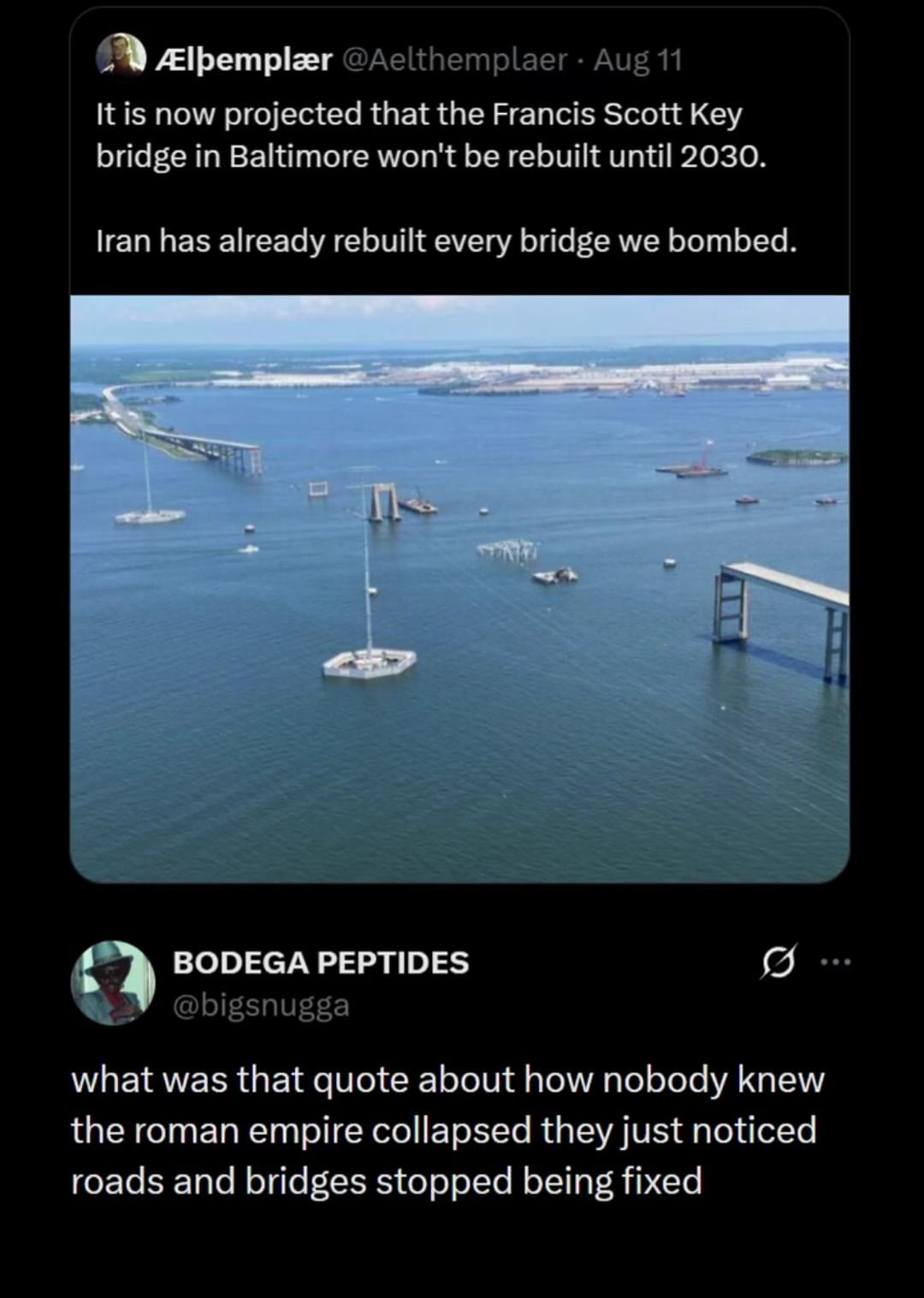
The USA certainly has rotting infrastructure additionally suffering from slow construction times, and inflated costs with bloated contracts going to feed leeches at the “top” of our trickle-up chain.
But the claim “Iran got all their bridges fixed” needs citation and sounds like some made up bs - it’s very likely they repaired some of them, but the Iranian people have been suffering from massive bombardments for months, as well as decades of sanctions, and earthquake on top of this, so doubtful they have repaired most of what has been damaged, let alone all.
The decline of the Roman empire was a wild thing for the people actually living on the ground. Imagine you’re living in Alaska. You were born there and have never considered yourself anything but American. Your home is, as far as you’re concerned, completely inseparable from America and as American as any other part of the country.
One day you see an emergency press conference on the TV. It’s a press conference by governor. They’re announcing that they just received word from Washington. The message said:
“We’re sorry we have to do this. But the federal government just can no longer maintain our presence in Alaska. The country just can’t afford it anymore. The national finances are exhausted and the nation must consolidate down to focus on its core territories. You will no longer be federally taxed, all federal troops will be withdrawn from the state, no federal dollars will be spent on the state, and Alaska will no longer receive representation in Congress. Existing US citizens in Alaska will retain their citizenship, but new children born in Alaska will be subject to the same citizenship rules as those born to American expatriates living overseas. We are granting Alaska full independence. We wish you the best. Good luck. But you are on your own.”
Imagine what it would be like to be a resident of Alaska and to hear that message. How do you even respond to that? Do you stay in the US, leave Alaska, and move to the lower 48? Do you try to stick it out in the newly independent Alaskan nation? Can Alaska even survive as an independent nation?
In the modern world, we’re not used to national governments just packing up and leaving a state or province. Governments work so hard to suppress even the possibility of revolt that the idea of one just abandoning a state or territory is a strange concept. But historically this does happen with declining empires. It really wouldn’t even be that crazy of a move for a declining US. Alaska is a part of the US, but it isn’t a core territory. The lower 48 is really the core of the United States. Territories beyond this are mostly money sinks useful for either resource extraction or power projection. Nice things to have, but not the US’s core population and economic centers. I can foresee future scenarios where the US eventually just walks away from places like Alaska, Hawaii, Puerto Rico, and other territories not contiguous with the US mainland. No empire lasts forever, and collapse tends to move from the periphery inward. On the ground in the periphery, this looks like the national government just announcing you’re no longer part of the country.
It should have been Canada all along anyway. Alaskans are just secret Canadians with a deed to the area.
You don’t have to look back that far. Austria 1918 was pretty much that, except that not a region on the edge was lost but the capital Vienna lost most of the hinterland with the remaining rump state not considered viable. One of the largest cities on earth, at the time, went from exponential growth into decline. Population size still has not recovered, 100 years later.
“Territories beyond this are mostly money sinks useful for either resource extraction or power projection.”
how can somewhere be both a money sink and useful for resource extraction? that’s just paying for resources
Something can be necessary and useful while still be an unprofitable money sink. I pay for water from my city’s utility. It’s a useful resource, but it’s still a money sink. I don’t earn any profit from the water I get from the city. In fact, it all goes down the drain in one form or another, and I have to pay even more money for the city to take the used water off my property! I absolutely need it; I couldn’t live in the home I do if the water was cut off. But it’s not a profit center for my household finances. Just because something is necessary and useful does not mean it is profitable.
It always goes back to rights and responsibilities. Assholes want all the rights, none of the responsibilities. You will see this pattern everywhere in life.
FWIW, Alaska and Hawaii are both key strategic locations for the US military which is why they are currently under US control.
Yes. But we’re talking about a scenario where the US is collapsing like every other empire before it has. Rome would have liked to keep hold of England, but they just couldn’t afford it anymore. Alaska is a nice thing to have strategically, but it’s not a core engine of the US economy or one of it’s major population centers. It doesn’t pay for itself. When empires decline, these far flung “nice to have” territories are the first to go.
Can Alaska even survive as an independent nation?
I think the US annexes parts of BC and Yukon to make a land bridge to Alaska before it gives it up. I’d see it giving up on rural parts of Pennsylvania, all of WV, and Illinois first. I know there’s no mechanism for a state to secede, but what about splitting into parts and only one part keeps the state name/legal status, and the other part just becomes a landlocked entity that has to pay a protection racket but gets $0.00 in federal funding back?
Alaska with its oil, refineries, and spots to park radars make it too nice of a place to hold onto. If in some misguided attempt to Own the Libs or whatever the US did split off Alaska, then whenever someone got up there from CONUS again they’d find English as a third language, if it all, with Mandarin second and whatever native tongue as the first language.
A land bridge wouldn’t really help with the finances. There’s already a few roads that go all the way up to Alaska. Most things going from the lower 48 to Alaska still are shipped by sea or air.
It’s not the fact that Alaska isn’t contiguous with the US that is the problem. The problem is that Alaska is very far from the US’s core population and economic centers, and Alaska itself has little population, and most of its land has extremely low economic value. Adding more low-productivity territory between Alaska and the US won’t change that equation. (Vancouver is definitely not a low-productivity territory, though capturing it by force would be a nightmare.)
Think of it this way. A country has economic engines and economic sinks. The engines provide the tax revenue to cover everything else. The engines are your major industrial cities, your big population centers, agricultural areas like the Mississippi Valley, etc. The engines are what provide the core material needs of the society. The sinks are territories you annex not to serve as economic engines, but because they provide non-economic value. Maybe they provide a place to station troops or naval forces, making it harder for an adversary to invade your core engines. Maybe they provide a vital strategic resource like oil. You can always trade for these resources, but owning the land they’re under means you can’t be cut off from these resources by a trade embargo. Maybe you annex a territory simply to prevent it from becoming a lawless failed state that would cause trouble to spill over your border.
You take on sinks because they increase the safety and stability of your core regions. Alaska does not pay for itself, not even close. It’s valuable to the US because it serves as a valuable place to station troops, and because its oil and other resources cannot be cut off through a trade embargo. And we’re better off having it rather than letting Russia having a foothold on the continent. If anyone proposed cutting off Alaska today, I would call them an idiot. Having Alaska is the US purchasing an insurance policy against future disruptions. But like any insurance policy, on average it costs you more than it pays out.
But in the scenario we were considering, the US simply can’t afford to maintain these “nice to have” territories anymore. It’s like when you lose your job and have to cut back on expenses, sometimes insurance is something that has to get cut.
If anyone proposed cutting off Alaska today, I would call them an idiot.
I agree.
A land bridge wouldn’t really help with the finances. There’s already a few roads that go all the way up to Alaska. Most things going from the lower 48 to Alaska still are shipped by sea or air.
We’re acting like finances are infinite already, and as long as people keep trading in dollars they are. And in this scenario we’re not considering what does/doesn’t make sense; we’re considering the idle thoughts of one person worried about his image.
I was working on an argument to try to justify having a big road all the way up through BC to Prudhoe Bay, and having a railway as well, but I can’t make it make sense with the pipeline already in place unless you just really wanted one or were trying to add a dependency on railway travel to that area. Greenland doesn’t make sense to me, either, and that’s apparently moving ahead.
But in the scenario we were considering, the US simply can’t afford to maintain these “nice to have” territories anymore. It’s like when you lose your job and have to cut back on expenses, sometimes insurance is something that has to get cut.
As long as there’s a market for US dollars the US doesn’t have to drop anything. I know I’ve made a dissatisfying, reductionist argument, but it is what it is. In the event that people still trade in dollars we can keep on as we have, and as long as we don’t go around alienating allies and threatening to not fulfill military treaties there’s no reason that should stop. If that did happen then going to war is a time tested way of giving the economy a boost.
Starting a war with Canada would just accelerate the collapse, kind like Russia invading Ukraine is doing.
Further, a land-bridge to Alaska actually adds to the problem that it costs as lot more money to maintain a military and administrative presence there than the money it generates because now you have to ALSO maintain a strong military presence in BC and Yukon all the while the locals are trying to fuck you up and the rest of Canada is engaged in guerrilla warfare not only there but also against the US presence in Alaska.
Even at best the US would be militarilly bogged down for DECADES in an Occupation of part of a country whose people look exactly like Americans and speak the same language whilst being extremelly pissed off, in a area with incredibly porous borders, borders which such action would have just extended to be far bigger and crossing even more far out and wilder land, all for the sake of a piece of land that even before such an extension and the necessary military occupation to hold it against the enemy next door thus created, did not actually pay enough for its upkeep.
Even more entertaining, whatever natural resource extraction that could be done to pay for it, can already be done since the Alaska is US territory (so there must be good reasons for that not to happen), only under such a scenario it and any transport links for whatever it extracted would be the target of Canadian drones, which it is not now.
Starting a war with Canada would just accelerate the collapse
you have to ALSO maintain a strong military presence in BC and Yukon all the while the locals are trying to fuck you up and the rest of Canada is engaged in guerrilla warfare not only there but also against the US presence in Alaska
the US would be militarilly bogged down for DECADES
I agree with you, but I would wager that Canada’s participation in the F-35 program has more to do with not having the land bridge than your points. We’re already doing our version of “little green men” in Greenlands, so it’s hard to use history or what makes fiscal sense as a guide.
I’m on team No Land Bridge, but I also see the US never giving up Alaska.
Yep and whether or not the air crew tasked with vacating those areas will comply with an order to is a REALLY big IF, should the 50 states start separating
If I was from Omaha and currently flew jets out of Pearl Harbor…I think I’d stick to the coast
I don’t think this really captures what it would have felt like to be abandoned by Rome.
For all it’s ills Rome brought civilisation and technological advantages to the places it conquered.
When Rome withdrew I think the most keenly felt loss in many areas would have been to be cut off from that ordered civilisation.
One moment you’re a citizen of Rome, and the next your grain is looted and your daughters have been taken by barbarians.
It might be something more like, an announcement that it’s no longer profitable to maintain internet access for your entire country, so the network is simply being shut off, never to return.
As an aside, I’m in Western Australia. In terms of national identity I think many of us are fairly ambivalent to being “Australian” as opposed to being “Westralian”. 50 years ago there was a referendum about succession which actually won support - we chose to succeed from Australia. The Australian government saw sense after that and acquiesced to our demands, so it never went ahead. My point is though, if you live in a place and that place is cut off from the broader nation, do you lose your national identity or does your existing national identity just become more closely defined.
1933 referendum is a bit more than 50years ago by my count…
If you’re thinking of Lang Hancock’s campaign in the 70s there was no referendum
https://en.wikipedia.org/wiki/Secessionism_in_Western_Australia
BTW it’s secession and seceding - spelt with a u it means something totally different
In the modern world, some other country (Canada or maybe Russia, in your example) would immediately annex it.
Honestly, by the time such a thing happens, it’s very likely as well that ambitious, smarter leadership were quick to grasp the reigns months or years in advance, so that there is some semblance of local governance when the hegemony disappears.
What’s as likely to happen is that American becomes it’s own Triumvirate with leaders ruling over seperate areas that rely oj each other for survival.
Yeah, I don’t think so.
Yeah, I don’t think
so.FTFY.
Checkmate, atheists energy.
The white empire is.vast. it first looks like countries like south Korea geopolitically realigning away from the USA and the military bases closing
You think anyone would ever announce that you nk longer owe taxes? Nah man rome still collected taxes. Probably stepped up the guards, too.
But they stopped maintaining everything else. Like the roads. And the bridges.
Think about what you are saying. Actually think through the scenario you are suggesting. So Rome withdraws all its military and officials from England, and still keeps collecting taxes…how exactly? When you withdraw from an area you lose the ability to collect taxes there.
I never said they withdraw their full military and tax collecting officials. They leave a skeleton crew to collect taxes, and let everything else fall apart.
Matter of fact I’m pretty sure that’s an accurate description of the collapse of rome. Shit took a thousand years for a reason.
I think you are both partially correct. Either the government, or some ambitious political grifter who sees the writing on the wall, and manipulates circumstances to his advantage, are going to keep collecting taxes for as long as possible, before finally leaving. It will be the very last thing they give up, long after they’ve given up everything else.
I’d wager that even when the government is no longer able to collect taxes, it won’t announce that you no longer owe them taxes.
“Hey, you lot, you’re now Byzantines.”
“What, no we’re Roman.”
“No, it’s cool, it rolls off the tongue, give it a year, you’ll love it.”
“No, we’re part of the Roman Empire.”
“No, think about it, Byzantine empire. Sounds majestic.”
“…”
“Catch you later… Bring tithes.”
You’re making a joke but people in the Byzantine empire called themselves Roman. Greeks living in 1920s Turkey still called themselves Roman.
That would be funny but it’s pretty unlikely to be true. Fixing bridges has got to be fucking difficult.
That’s why it’s a war crime.
It’s not as difficult as you might think. Or, more precisely, it’s a lot more difficult to destroy a bridge than you might expect. Look at how much trouble Ukraine has had trying to keep the Kerch Strait bridge out of commission. Or look at the hundreds of bombing runs the US did in Vietnam to try and knock out one stupid bridge.
It’s easy enough to temporarily shut a bridge down. Bombing its road deck is pretty easy. The deck is usually exposed to the sky, so bombs can be dropped right on it from above. And the deck is thin enough to be fairly vulnerable to bombing.
The problem is that bombing a bridge deck doesn’t actually destroy the bridge. At best you create a hole in the bridge deck a meter or two across. That can shut a bridge down temporarily, but it doesn’t actually damage the bridge’s structure. To repair the deck you do something like:
- Clean up the hole. Remove any loose concrete chunks with a hammer, cut off any exposed rebar with an angle grinder.
- Drill holes at regular intervals through the edge of the hole.
- Run new rebar spanning the hole. Epoxy rebar into old bridge deck.
- Attach some plywood to the bottom side of the bridge deck to server as as mold.
- Pour new concrete and let cure.
This can be done in a day or two. And on a multi-lane-bridge, traffic can continue to flow around the bomb site at reduced capacity.
If you actually want to destroy a bridge, you can’t just hit a random spot on the bridge deck. If it’s a big truss bridge, a direct hit on a key truss member could cause the entire bridge to collapse. But those are very precise targets to hit. And if it’s just a bridge deck sitting on beams sitting on piers, the only way to destroy the bridge will be to knock out the support piers.
The problem with destroying them is that bridge piers are both hard to hit and extremely resilient. They’re protected from above by the bridge deck, so to hit them you’ll have to glide a bomb in horizontally. And even if you manage to hit them, they’re utterly massive. They have to support the entire weight of the bridge above. Plus they’re often directly in a river’s channel. This means they’re built to survive the forces of water current and ice collision if the bridge is in a temperate climate. Plus they’re built extra thick to resist the corrosive effects of the river water. Now, if you do actually manage to knock out a support pier, replacing it will be a nightmare. But that’s a very difficult thing to do.
It’s actually a lot more difficult to destroy a bridge than people realize. Knocking a hole in a bridge deck is easy. But bridge decks are easily and quickly repairable.
This is kina dumb. Seeing how they can precisely land a missile on a car going 100kph on the other side of the world.
Blowing up a car is way easier than blowing up a bridge.
And yet, your gut feelings are incorrect. As has been clearly demonstrated by the well documented difficulties militaries have in keeping bridges down through air power alone. But sure, tell the literal structural engineer you know more about bridges than she does.
Now that we caught an actual structural engineer, here’s a question from a fellow engineer (but the wrong kind to know this):
- Would it be harder to repair a suspension bridge (or at least the suspended span of a bridge with one)?
I’m thinking of the top of my head that the forces and dynamics of a suspension bridge are very different from those of a more traditional bridge and thus that if the actual cables holding it are blown up at the anchor points, the whole suspended span just brings itself down as a whole leaving just the pillars.
Further, suspension bridges tend to be used for longer lengths of bridge were you can’t really have pillars in the middle (in this example in the US, the suspended spawn being there so that ships can cross under the bridge)
Note/Dislaimer: the information here is purely hypothetical and educational, discussing the limits of Air Power as a means of severing enemy transportation links. The Golden Gate Bridge is used as a familiar example when discussing the vulnerability of suspension bridges. But the author of this post has zero desire or intention to damage the infrastructure of the US or any other country. Nothing in this post should be taken as a threat or warning of any kind.
Your instincts are correct. The forces are very different. If one of the main cables on a suspension bridge is severed, the entire bridge deck will come down. You would be able to reuse the towers, foundations, and maybe some of the vertical cables supported by the main cable that wasn’t hit, but repairing such damage would be similar in difficulty to rebuilding the bridge from scratch. Demolition and restoring that bridge deck probably represents about 50% of the work of building a whole new bridge from scratch.
However, actually severing one of the main cables is lot more difficult than you might think. They’re not a giant rod of solid steel; they’re thousands of individual pencil-sized wires bundled together. At the anchorages, these individual wires spread out and embed themselves into a giant block of concrete. Here are the Golden Gate Bridge’s anchorages under construction.

Those steel elements are only a portion of the total, and after they were built, the entire volume was filled with concrete. The Golden Gate Bridge’s anchorages are giant hunks of heavily reinforced concrete. Imagine a cube of super-reinforced concrete 12 stories to a side. That’s the scale of what we’re talking about.
You can absolutely forget about destroying one of the anchorages directly. They would be trivial to hit. They’re giant hunks of concrete. But anything short of an atomic bomb would have trouble doing significant damage to them. While bunker-buster bombs exist, those are made to punch a hole through many feet of concrete and then explode in the air below the concrete. They’re not designed to turn a massive 30 meter cube of solid concrete into gravel. It takes a minimum amount of energy to pulverize something that large. And that amount of explosives just can’t be delivered by a plane or missile. And even if a bomb takes out a chunk of an anchorage, you’ve only managed to sever a few dozen of the thousands of wires holding up the bridge. Destroying the anchorages themselves would be even more impractical than destroying regular bridge piers.
So that leaves the cables themselves. You mentioned severing them at the anchorages, but it actually doesn’t matter where they’re severed. Imagine hanging a rope between two walls in the room you’re in now. It doesn’t matter where you cut that rope; anything hanging from that rope is going to fall. However, the best point to target would be right where the cables hang from the supporting towers. That is where the tensile forces in the cables are at their maximum.
I’m no expert in military ordnance. I have no doubt the Air Force has studied the problem extensively, but I really don’t know how effective bombs are at taking out suspension bridge cables. I don’t know exactly how precise the US Air Force is nowadays with their precision bombing, but I’ll take it for a given that they have the ability to reliably get a direct hit on one a 1-meter wide bridge cable. Unlike in Vietnam, I’ll assume we can actually hit the thing reliably.
You’re talking about a cable that is made of thousands of individual wires. The Golden Gate Bridge’s main cables are a meter thick. They look like this.

This isn’t the type of target most military bombs are designed to destroy. Broadly speaking, there are two main types of bombs. There are area weapons and penetrators. The area bombs subject a large area of ground to heat, shock wave, and high speed debris. Some bombs are designed to say, kill every unarmored person and any lightly armored vehicle within a hundred meter radius. These area weapons would be completely useless on bridge cables. Even with a direct hit, most of the explosive force would bounce off the cable and into the air. You’ll probably sever a few of the surface wires, but the vast majority of the cable’s capacity will remain intact. And those things are built with a factor of safety. The Golden Gate Bridge was built with a factor of safety of about 2.5. Which means in theory you could cut through more than half of both of each main cable’s cross-sectional area, at the point of maximum cable tension, and the thing would still stand.
That leaves the penetrators. Bunker buster bombs have already been mentioned. But what I’m thinking of are the shaped charge weapons designed to punch through things like tank armor. These weapons work by using an explosion to create a pencil-sized jet of superheated molten metal. This instantly drills a small hole through the armor of a tank. This is effective at destroying tanks, as that superheated stream of metal enters the tank cabin, rapidly expands, ricochets off the walls, and pastes everyone inside. And the resulting rapidly expanding gases can blow the turret right off some tanks.
But where my knowledge fails is how effective these shaped charges would be against a meter-thick bundle of steel wires. A shaped charge would certainly be capable of punching a hole, but if you want to sever the cable, you need to sever the entire cross section. A shaped charge may not have enough energy for that, or the stream of vaporized metal might just pass right through the cable, in one side and right out the other. I won’t say it’s impossible, especially if you designed a bomb specifically for targets like this. But whether a shaped charge that is designed to puncture tank armor can sever a big suspension bridge cable? I’m sure the Air Force knows, but that’s beyond my expertise. I’m sure it’s been thoroughly studied, and I’m sure those studies are classified to all hell and back. It’s possible there may be information on this publicly available, but I feel dicey enough posting about severing suspension bridge cables on a public forum like this. Even if such info is publicly available, I would rather not have some angry men in black suits show up on my front porch asking why I’ve been reading numerous papers on how to effectively sever the cables of giant suspension bridges. I don’t need that in my life right now. 😅
On the plus side, this actually makes big suspension bridges very resilient to terrorist attacks. A specialized shaped charge missile built by Lockheed Martin specifically to sever large suspension bridge cables could do the job. But you can’t destroy the Golden Gate Bridge by setting off a home-made truck bomb on it a al Oklahoma City. You would blow a hole in the bridge deck, kill a lot of people, maybe sever some of the support cables, and maybe damage some of the outer layers of the main cables. But if you set of a truck bomb right next one of the main cables, again most of the explosive force would just bounce off. A meter thick steel element is pretty damn resilient. I’m not aware of any incidents of a major long-span suspension bridge being taken down by terrorist bombs like this.
I have extensively worked in Demolition. Salvage, and Scrap. Breaking shit is only hard when you are using the wrong tool for the job.
And unfortunately for the US Air Force, planes and bombs are the wrong tool to take down a bridge.
I’m going to assume that with a simple jackhammer or a few small shaped charges, some time to work, and a lack of concern for your own life, you could “proper tool” a bridge to the ground pretty easily.
Exactly. Give me a couple days and a big enough angle grinder and I can take the Golden Gate Bridge down. (Assuming I have no regard for my own safety.) But the big steel cables holding the bridge up can be cut just like any other steel. Of course, I don’t actually want to take down the Golden Gate Bridge. But even if I did, it wouldn’t be having the right tools that would prevent me from doing it. It would be the fact that if I tried it, I would probably be beaten to death by a crowd of angry people before the police could even arrive. You show up with a giant cut off disk and start going to town on the cables supporting a bridge holding up thousands of cars? You probably won’t even live long enough to see those terrorism charges.
That’s the problem with taking bridges out from the air. You can’t get up close and use the proper tools. You have bombs, missiles, and that’s it.
It’s hyperbole, but it does appear to be based on fact
https://www.msn.com/en-us/news/other/satellite-images-show-iran-is-rebuilding-fast/ar-AA28yvnd
Depends on what you call fixed. Good enough to work, maybe. Back to original condition, I really doubt it.
Yeah, it’s not really a direct comparison. Bridges in Iran are generally badly damaged like this (real examples):


But the Francis Scott Key bridge is fully just gone for the entire load-bearing span and needs to be rebuilt.
That’s pretty easy to fix. The bottom image just has a hole in the bridge deck. Clean up the hole, epoxy in some new rebar, build some forms, pour new concrete, and you’re done.
The top image is worse, but it’s still not as bad as it seems. Look closely at that bridge. That looks to be a bridge made of precast concrete. Look how the whole fallen span seems to have come down in one big piece. It’s a very clean break.
When I say precast, I mean literally that. The beams for that bridge are not poured on site. They’re made in a factory and trucked in. A precast concrete plant could have a whole yard full of beams just sitting there, ready to go. How you build such a bridge:
- Construct bridge piers by either casting in place or driving precast piles into the ground.
- Either cast the pier top caps in place or use precast caps carried in and placed by crane.
- Hoist precast beams and place them spanning the top caps.
- Once beams are in place, construct formwork and cast a bridge deck on top of the precast beams.
In a bridge like this, often the only part that is poured in place is the bridge deck. To fix the bottom bridge, you would remove any debris, clean up the edges, drop in some new beams, build some forms, and cast a new bridge deck.
And what I’m describing is just typical precast concrete bridges. I’m describing what you can do even when you haven’t optimized your whole bridge construction sector for easy repairability. But Iran has been preparing for a US attack for a generation. The reason the US’s decapitation strike failed to cause a regime collapse was because Iran isn’t some tin pot dictatorship lead by one brutal despot. It’s an advanced nation that’s built its governmental system from the ground up with survivability in mind. There was an elaborate continuity of government plan in place, and as the US and Israel assassinated Iranian leadership, the conveyor belt just moved folks up to replace those killed. It’s a modern day governmental version of the ancient Immortals. Iran’s even granted a lot of their military forces a high degree of autonomy. There are a whole bunch of missile crews hiding in underground bases with standing orders to launch at pre-chosen targets if they don’t receive word from leadership after a certain amount of time. In short, Iran has gone to great lengths to make its government and military highly resilient to attack.
And if they did this for their government, why not their infrastructure? You can design bridges with quick repairability in mind. For example, you can standardize sizes as much as possible. Instead of custom designing everything, design your precast bridges to use only a small number of different beam sizes and standardized length. You tell your bridge engineers:
- All bridge spans must be in 2 meter increments, 4m, 6m, 8m, 10m, 12m, etc.
- All bridges must be built from one of six beam cross-sections. Do not design custom sections.
- All bridges must be designed to use the minimum strength of concrete any of our batch plants produce.
- All bridge decks must be designed to use the lowest grade of rebar commonly available.
- The distance between bridge beams must be in one of a few allowable dimensions to allow the use of pre-made drop-in formwork. * All bridges must be constructed with precast piers, pier caps, and beams with bridge decks cast in place using drop-in metal formwork.
- All bridge piers must be designed with twice the usual factor of safety, ridiculously overbuilding them to make them extremely resistant to bomb damage.
I have no idea what Iran is doing. But I do have a background in structural engineering. I’ve taken a literal course called “bridge design.” If you asked me to design a nation’s bridges to be extremely repairable, this is how I would do it. The piers are the hard part to replace, so you make those far, far stronger than they need to be. That way if a bomb blows off a chunk of a bridge pier, there’s still plenty of capacity left. Everything else? You standardize the hell out of it and then mass produce and stockpile replacement parts. If you only allow six beam sections and 6 beam lengths, that means there will only be 36 types of beams used across all of your bridges. You can then produce and stockpile huge numbers of these beams, allowing extremely rapid repair after an attack.
We typically don’t build bridges to this level of standardization. The problem with using few standard sizes is that you inevitably end up over-designing your bridge. You can’t design the perfect custom cross-section to carry your loads with the absolute minimum amount of material possible. So your bridges end up heavier and more expensive than they could otherwise be. But if you’re willing to pay a bit more for a much, much more resilient transportation system, standardization can accomplish this.
Again, no idea if Iran is actually doing this. But considering the lengths they’ve gone to make their whole regime resilient to attack, it wouldn’t be unreasonable to assume they’ve applied the same philosophy to their physical infrastructure. You don’t try to build an indestructible bridge. You just make your bridges easy to repair instead. If you do it right, repairing a bridge will be far cheaper than dropping a bomb on one.
Just to add to this, notice how low the water levels are. It’s summer, the river bed is practically dry, and most rivers have a dam upstream so the flow can be controlled. It kinda limits the impact of the bridge being down for even a few days or weeks, and my understanding is that it speeds up the reparation process.
Huh, thank you, this was extremely interesting!
And it’s over a very active shipping lane.
And the actual need for the bridge is marginal. I’t useful, but hardly ever busy. For non-hazardous, normal sized loads, there is a 4 bore super tunnel, for smaller loads there’s a two-bore tunel, Hazardous and oversized loads are hit hardest, but they just go the other way around the beltway. Coming south from 95 north of Baltimore to 95 south of Baltimore was a 40:60 shot between bridge and west beltway, longer but not unreasonable.
Shipping terminals in Dundalk used it as a primary exit to head south. Sparrows point isn’t the production powerhouse it once was. They’re going to drag their feet.
Sure but if you took the billions and billions spent on attacking Iran and instead rebuilt the bridge it could have been done by now.
Straightfowardly, no, it couldn’t be. Bridge construction on this scale isn’t just a matter of throwing money or people at the problem. Like the old saw that says you can’t get nine women to make a baby in one month, a 1200’ span takes time. Foundations have to be built below water, piers have to be formed and given time to achieve design concrete strength, and each bridge segment has to be completed in sequence, including formwork, rebar, concrete pouring and setting, etc., in a careful sequence that keeps the cantilevered sections of the bridge in balance.
The US is no paragon of speedy infrastructure projects, but even in China cable-stayed concrete bridges are years-long projects. The Changtai Yangtze River Bridge, for instance, has spans similar to the Francis Scott Key bridge and it took fully 6 years from start of construction to completion, never mind design time.
In addition, it’s worth noting that the Key Bridge was built to lower standards than are acceptable today, so it has to be completely redesigned and rebuilt - we can’t just slap up another bridge of the same design. Plus, with the circumstances that caused it to collapse, you can bet that any replacement bridge will be very much reinforced against a similar incident, probably to the point where it’s almost too strong given the likelihood of another incident like that.
There are so many people on Facebook that seem to think it should have been rebuilt already. They think Maryland should already have had plans to rebuild it in the file…it’s likely they are the same people that also bitch about taxes every chance they get. I have the strong impression many of them aren’t even local; they’re just stirring the pot, trying to make Governor Wes Moore (a Democrat) look bad; they actually have no stake in the game and probably have never even been to Maryland.
this user bridges
*Dad voice - fixing bridges is a war crime?
But I’m actually a bridge engineer and you’re spot on, shit takes a shocking amount of time even for small, simple bridges. That’s why they last for 100 years.
That’s why it’s a war crime.
Depends on who’s doing the bombing.
The USA don’t answer to nobody.
Whether or not it’s enforced, it’s still a war crime. History will recount it as an atrocity, with footnotes that putting Trump in power was a bad thing, and we as a people should reflect on how to not do anything like that again.
I mean, granted, we try to live down the genocide of the first nations here in the US, or our economy depending on slave-run sugar and cotton plantations, but it keeps coming back to haunt us.
Depends who writes History.
That said, what’s going on in the US (not just now but for at least 1 or 2 decades) parallels the typical historical Fall Of Empire so much that it’s unlikely that those who write this part of History will be the current political forces in the US.
Bombing bridges is a war crime?
But bombing humans is not? 🧐
Bombing humans is a war crime.
Bombs are supposed to be used to destroy the infrastructure that their military depends on.
Once you’re bombing to reduce population, you’re also doing what Sun Tzu says is an absolute last resort, and should be ashamed of your skills as a commander.
Okay yeah, that makes sense. But bombing bridges is also a war crime though? Sounds a lot to me like bridges are “the infrastructure that their military depends on”. Am I thinking about this wrong? 😅
If the bridges are in the theater, then yes. In fact they become strategic hot points and bombing them can be important.
But in the case of Iran, it was entirely air, missiles and drones, and so the US was hitting bridges just to inconvenience the civilians.
Granted, if the US invaded with troops and mechanized armor, then those bridges would be useful as the front line advanced, but we have improvised pontoon bridges for that.
Makes sense, thanks. I think every war action that is technically a war crime should be reported as such in the media. Why are the media so slack on this? Like even independent media.
This would open people’s eyes a little more, I would hope.
There’s more nuance to it. It mostly depends on skin color.
Ah yes, makes sense 🙃
If you don’t let us bomb humans, how are we supposed to do war!?
- some world leaders, probably.
In slight fairness… 2030 is not nearly as far away as it feels like it should be. :)
:3 years
I don’t like you anymore.
Yes, exactly. I hated it when I did the math so I had to share the pain <3 lol

You can speed things up in the US simply by spotting Trump a few million.
Yeah but the work will be shoddier than of you just invested a million more in your buddy’s bridge guy.
The rise of the Persian and Ottoman empires‽
Were Ottomans caused by fall of Romans or fall of Seljuks?
Irony being Iran = Persia.
Should have put the bottom comment about the roman empire as the title.
The U.S. has not directly bombed Iran’s domestic civil infrastructure in modern conflict. Couldn’t find anything about bridges being taken out
There’s literally video of it, lmfao.
There were at least 2 in early part of war. More threats than actions in last 2 months.
We bombed, hey?
Oh boy
Lots of words saying there’s a difference. I gotta agree.
You’re blocked for being a divisive cunt.